
Website Design for Landscapers Focused on Better-Fit Projects
Help homeowners, property managers, and commercial clients understand what your company creates, maintains, and improves. A professional landscaping website should connect your services, service area, project examples, team, process, and customer proof in one clear online presence.
Evergreen Web Solutions creates contractor-focused websites for landscape design, installation, lawn care, outdoor lighting, seasonal work, and property maintenance. The goal is not simply visual appeal. It is to help potential customers see whether your company fits their property, priorities, and project type before they request a free estimate.
No pressure, generic design package, or promise of a specific number of leads.

YOUR WEBSITE SHOULD REFLECT THE WORK YOU WANT
A Landscaping Website Has to Do More Than Look Attractive
Landscaping is a visual service, but attractive photos alone do not explain the scope, planning, craftsmanship, or ongoing care behind a successful property. A visitor may be considering a complete outdoor renovation, a planting plan, regular lawn care, irrigation improvements, hardscaping, landscape lighting, or commercial maintenance.
Each potential customer needs to quickly determine:
- Whether the company provides the needed landscaping services
- Whether the property is inside the service area
- Whether the team handles residential and commercial services
- Whether the company has completed a similar project type
- What design, installation, or maintenance process applies
- Whether the style and quality of the work match the customer’s goals
- How to request a free estimate or free consultation
- What happens after the customer makes contact
A well designed website should guide visitors toward relevant information without overwhelming them. Clear structure, strong photography, and useful service descriptions help the landscaping business make a confident first impression.
FROM OUTDOOR IDEA TO QUALIFIED INQUIRY
Landscaping Website Design Should Support the Customer’s Decision
Some visitors know exactly what they need. Others have a general goal more usable outdoor space, easier maintenance, better curb appeal, improved drainage, or a healthier lawn but need help deciding which services fit the property.
Effective landscaping website design should support that process through four stages:
01
Clarify the Goal
Help the visitor identify whether the need involves landscape design, construction, lawn care, maintenance, outdoor lighting, drainage, planting, or another major service.
02
Show Relevant Experience
Connect each service with project galleries, customer testimonials, team information, process details, and examples of related work.
03
Explain the Fit
Clearly present the service area, typical project type, commercial priorities, scheduling expectations, and any important limitations.
04
Make the Next Step Clear
Provide a simple path for potential clients to request an estimate, schedule a consultation, or ask a question.
The website cannot guarantee that every inquiry will become a project. It can help the business attract qualified leads by giving customers enough information to evaluate the fit before contacting the company.
COMMON CONTRACTOR WEBSITE PROBLEMS
Is Your Construction Website Making Large Jobs Look Small?
A contractor may complete substantial renovations, additions, ADUs, and custom builds while its construction website looks like it belongs to a general handyman. That mismatch can affect how prospective customers understand the company before the first conversation.
Your site may need improvement if:
- Major construction capabilities are combined on one short page
- Large projects are mixed with minor repair work
- Completed work appears in an unlabeled photo gallery
- Visitors cannot tell which communities you serve
- Your best work is difficult to find
- The site does not explain your planning or construction process
- Reviews are separated from related work
- Licensing, insurance, or other qualifications are difficult to verify
- The inquiry path does not gather enough useful information
- Project expectations are not addressed before the inquiry
- Important pages are difficult to use on a phone
- Stock images make the company look generic
- The site does not represent your current level of work
- Calls to action do not explain what happens next
- Search engines cannot clearly understand your primary work and locations
A successful redesign should correct the problems that create confusion, weaken trust, or prevent a qualified visitor from taking the next step.
BUILT AROUND HOW GENERAL CONTRACTORS WORK
What Professional Construction Website Design Should Accomplish
Every construction company has a different mix of work, team, market, sales process, and level of capacity. Professional website design services should reflect those differences instead of forcing the business into a generic home services template.
Position the Company Around Its Best Work
Your site should emphasize the work you genuinely want. A contractor focused on whole-home renovations and additions needs a different presentation from a company focused on decks, tenant improvements, insurance repairs, or custom homes.
Help Website Visitors Understand the Fit
Clear capability information, relevant examples, locations, process details, and frequently asked questions help visitors compare their needs with your capabilities.
Demonstrate Experience and Professionalism
Project photography, detailed case studies, customer testimonials, credentials, team information, and consistent business details can reduce uncertainty around a major construction decision.
Support a Longer Decision Process
A homeowner considering an addition or major renovation may research for weeks or months before choosing who to contact. The site should provide enough useful information to remain credible throughout that process.
Collect More Useful Project Information
A simple lead-capture path can gather enough context about the property, type of work, planning stage, desired timeline, and goals to support a more productive first response. It should remain easy to use, especially on a phone.
Create a Foundation for Search Visibility
Clear pages, descriptive headings, internal links, useful location content, mobile usability, metadata, and appropriate technical setup give search engines a better foundation for understanding the company. Search engine optimization begins with this structure, then continues through content, local relevance, authority, and measurement.
CONSTRUCTION WEBSITE STRUCTURE
Organize Your Construction Business Website Around Work and Locations
A strong construction website needs a deliberate structure. Visitors should be able to move from a broad overview to a specific capability, related example, useful proof, and clear call to action without becoming lost.
The correct architecture depends on the company, but it may include:
- A focused homepage
- Individual service pages for major construction capabilities
- A project portfolio
- Detailed project case studies
- An About page
- A construction-process page
- A service-area overview
- Useful pages for priority locations
- Reviews and testimonials
- Frequently asked questions
- A straightforward inquiry path
- Contact information and communication expectations
Major Capabilities Deserve Dedicated Service Pages
Whole-home renovations, additions, ADUs, kitchens, bathrooms, custom homes, commercial improvements, garages, decks, and other major types of work involve different questions and levels of planning. Dedicated service pages provide space to explain the work without forcing visitors to search through one general list.
Not every minor task needs its own page. The structure should prioritize the capabilities that represent your company and support its goals.
Project Pages Should Connect With Services
A completed kitchen renovation should connect with the kitchen-remodeling page. An ADU project should support the ADU service and the location where the work was completed. These relationships help visitors find relevant examples while giving search engines clearer context.
Location Pages Need a Genuine Purpose
A location page should contain more than a city name placed into repeated copy. Useful local pages can explain the services offered in that market, relevant project experience, property considerations, permitting or planning context when appropriate, and how to begin a conversation.
Only create location pages for communities the contractor genuinely serves and can support with useful information.
CONTRACTOR WEBSITE DESIGN INSPIRATION
Design Inspiration From the Best Contractor Websites
The best contractor websites do not all use the same colors, animations, or page layout. What they share is a clear understanding of the audience: website visitors can quickly see what the contractor builds, where the team works, why the company is credible, and what to do next. That is more useful than copying the visual style of another construction business.
When reviewing contractor websites, look for practical ideas rather than surface-level trends:
- Navigation that makes important work easy to find
- A homepage that gives strong project imagery center stage
- A portfolio page organized by build type instead of one endless gallery
- Residential and commercial examples labeled accurately
- Customer testimonials placed near the work they support
- A clear call to action that matches the company’s real sales process
- Mobile layouts that help visitors browse without pinching or zooming
- Client logos, awards, and affiliations used only when current and permitted
Great design should let the work speak for itself while still providing enough explanation to establish relevance. Finished projects, in-progress construction, team photographs, and short videos can demonstrate scale, workmanship, and construction management more effectively than generic stock images.
Clear communication, honest recommendations, and support built around your business.
Website Builders, Templates, and Custom Web Design
Website builders can be useful for very small businesses at the very beginning, but the template still needs thoughtful planning, writing, imagery, mobile testing, and search setup. A builder alone does not decide which pages a good contractor needs or how the company should position different kinds of work.
Some website builders also make it easy to add visual effects that slow the site or distract from the portfolio. A web designer should use motion and decorative elements only when they improve understanding. The objective of custom web design is not complexity; it is a coherent experience shaped around the business.
Most web design companies can build websites for many industries. Evergreen’s design services focus on helping contractors and home builders translate real-world capabilities into a useful online experience. That contractor-specific context informs the structure, copy, portfolio, and conversion path from the very beginning.
Choosing Web Design Services for Construction Companies
Construction companies comparing web design options should ask who plans the page structure, writes the copy, organizes the portfolio, protects existing URLs, tests mobile layouts, and provides support after launch. Some website builders make publishing easy, but they do not replace strategy. Likewise, some marketing experts build websites without understanding how builders qualify a residential or commercial job.
A good contractor website partner should be able to explain the design process in plain language and show how each decision supports visitors. Construction companies should also know whether the web design includes content, search setup, analytics, hosting, and ongoing changes or whether those are separate costs.
Evergreen combines contractor-focused planning with practical web design. We build websites to present real work clearly, guide customers toward an appropriate next step, and create an online foundation the company can continue improving. Great design supports the message and helps the work speak for itself; it does not hide either one.
What the Best Construction Websites Avoid
The best construction websites avoid vague claims, unlabeled photos, crowded menus, fake urgency, and pages created only to repeat keywords. Strong examples also avoid letting a generic template overpower the company’s identity. Your company website should look and sound like your team not like dozens of other builders using the same theme.
MARKET THE PROJECTS YOU WANT
Build a Construction Website Around Your Ideal Work
A general contractor may offer several construction services, but the site should make the company’s priorities clear. Each major category can use its own combination of copy, photography, process information, answers, and calls to action centered on the kind of job the company wants.
Whole-Home Renovations
Whole-home renovation work can involve structural changes, several rooms, multiple trades, material selections, scheduling, temporary living considerations, and extensive coordination. The page should demonstrate the contractor’s ability to manage complexity rather than present it as a collection of unrelated upgrades.
Home Additions
An addition page can explain the types of spaces created, design and engineering coordination, permitting, integration with the existing home, major construction stages, and examples of completed work.
ADU and DADU Construction
Property owners researching an attached or detached dwelling unit often need help understanding planning, use, site considerations, utilities, permitting, design, and construction. The page can provide a clear starting point without presenting generalized information as advice for one specific build.
Kitchen and Bathroom Remodeling
Interior remodeling pages should present the level of work the contractor wants. Detailed photography, layout changes, finish selections, trade coordination, and process information can distinguish a substantial residential renovation from basic cosmetic updates.
Custom Homes
A custom-home page should create a more complete presentation around planning, design collaboration, site considerations, construction stages, craftsmanship, communication, selections, and finished homes.
Garages, Decks, and Specialty Projects
Detached garages, covered outdoor areas, structural decks, workshops, and other specialty builds can be presented as dedicated capabilities when they represent valuable and repeatable opportunities.
Construction Management and Commercial Construction
Contractors serving commercial clients may need pages for tenant improvements, office renovations, retail construction, property upgrades, construction management, or facility work. The copy and proof should speak to property owners, managers, agents, and business decision-makers rather than relying entirely on homeowner language.
Only promote work your company genuinely performs. A focused site is more credible than one that claims relevance for every possible type of construction.
PROJECT PROOF AND CREDIBILITY
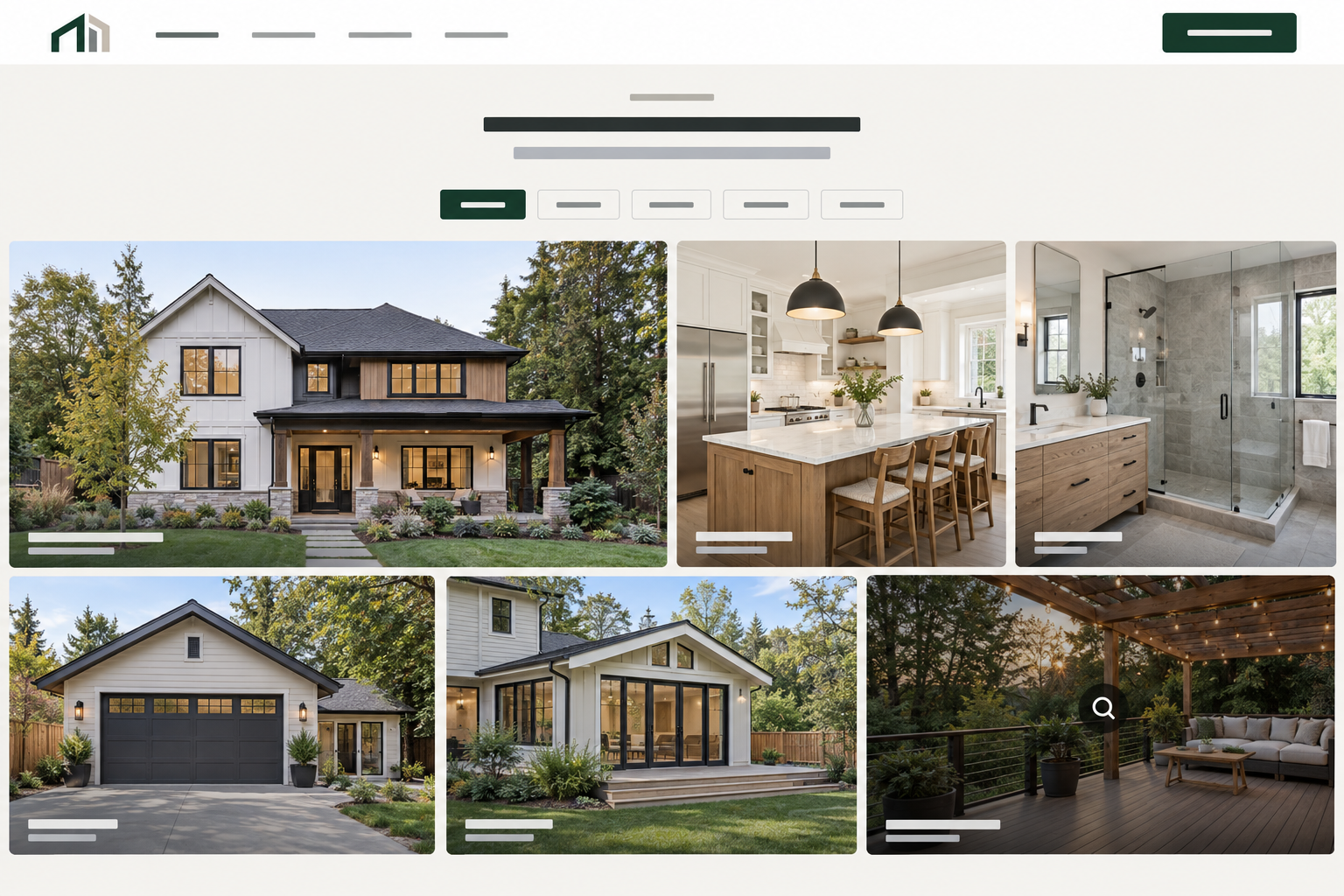
Give Completed Work and Customer Testimonials Center Stage
Potential clients evaluating a substantial renovation or build want more than a few attractive photographs. They want evidence that the contractor has completed relevant work and understands the level of planning, coordination, and communication involved.
A detailed portfolio feature may include:
- The general location when appropriate
- The type of work and overall scope
- Examples of the spaces, systems, or structures improved
- Examples of important planning or access constraints
- Examples of materials, finishes, or construction details
- Examples paired with relevant reviews when permission is available
- The client’s original goal
- Existing conditions or important constraints
- Design, engineering, or permitting considerations
- Major construction work completed
- Materials and finish details
- Before, during, and after photographs
- The finished result
- A related customer review when available
- Links to the relevant service and location pages
Portfolio descriptions do not need to reveal confidential budgets, addresses, or personal information. They should provide enough context to help a customer understand the contractor’s role and experience.
Use Real Construction Photography
Original project photography is one of the strongest assets available to a general contractor. Finished rooms are important, but progress photographs, structural work, craftsmanship details, crews, planning meetings, and jobsites can provide a more complete picture of the company’s capabilities. Short video content can also show a walkthrough, a construction phase, or the team explaining a completed build.
Images should be organized, compressed, and presented at an appropriate size. Large photo files should not make a page unnecessarily slow, especially for visitors using mobile devices.
Use Client Testimonials as Relevant Social Proof
Online reviews and client testimonials can explain communication, professionalism, scheduling, workmanship, problem-solving, cleanliness, and the overall customer experience. When appropriate, place a relevant review near the related service or portfolio example instead of keeping every testimonial on one isolated page. This builds trust without relying on unsupported claims.
Present Qualifications Accurately
Licensing, insurance, certifications, warranties, affiliations, awards, years in business, and other trust signals should only be displayed when accurate and current. The site should make important qualifications easy to find without turning every section into a list of badges.
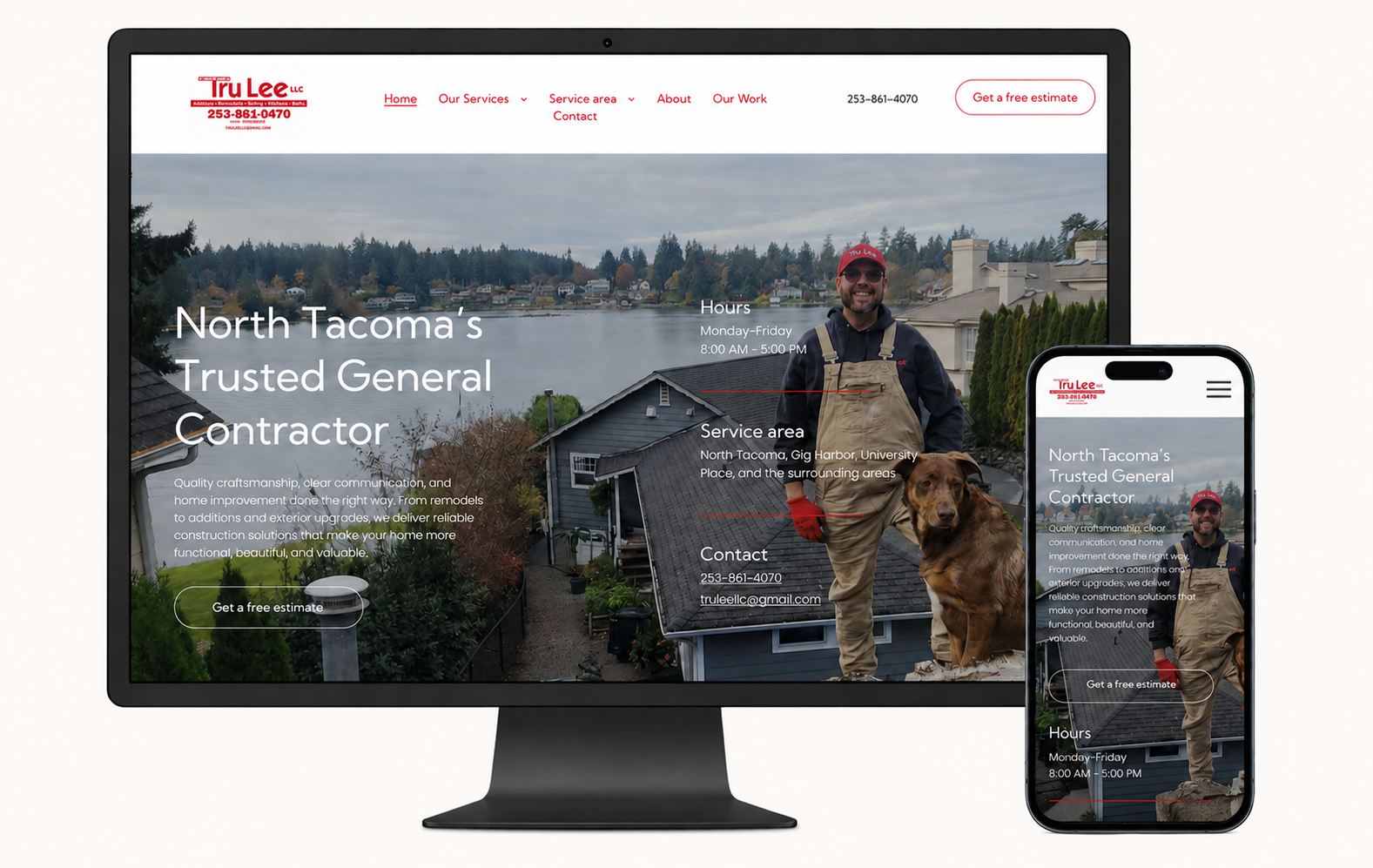
Client Feedback
“I’ve been using Evergreen Web Solutions for some time now for my general contracting company, and I absolutely recommend them for construction-related businesses looking to get their name out there. Riley is very responsive with managing the website, and the website design is professional and interactive.”
— Owner, Tru Lee Construction
Results vary by company, market, existing reputation, demand, and other factors. This example should not be treated as a guarantee that another website will produce the same outcome.
REAL GENERAL CONTRACTOR RESULT
Tru Lee Construction: From No Website to Four New Customers Within the First Few Weeks
ru Lee Construction needed a professional online foundation for its renovation, addition, ADU and DADU, kitchen-remodeling, detached-garage, and general contracting services
The Starting Point
Without a website, customers had no central place to review the company’s capabilities, understand where it worked, evaluate its experience, or submit an inquiry.
The Website Strategy
Evergreen Web Solutions created a professional website with clearer positioning, local search content, service-area targeting, trust-focused copy, and a simple way for homeowners to describe the work they needed.
The website was built to present the company more professionally while providing a direct path for prospective customers to ask about relevant work.
The Result
Within the first couple of weeks after launch, four new customers submitted forms through the website. Those jobs paid for the website and more.
PROJECT INQUIRIES AND QUALIFICATION
Make the First Customer Conversation More Productive
A lead-capture experience should not feel like an application designed to discourage people. It should be simple enough to complete on a phone while collecting enough context to help the contractor understand the opportunity and respond appropriately.
The page should also explain what happens next, when the company generally responds, and whether an inquiry schedules an appointment or simply begins an initial review. That clarity helps customers decide whether they are ready to continue.
Clear communication, honest recommendations, and support built around your business.
Use Calls to Action That Match the Sales Process
“Get a free quote” may be appropriate for some contractors, but it can be misleading for companies that need a consultation, site visit, plans, or additional information before discussing cost.
Alternative calls to action may include:
- Request a Project Consultation
- Tell Us About Your Project
- Start a Project Conversation
- Request an Initial Review
- Schedule a Discovery Call
The wording should reflect the company’s real process and set an accurate expectation. A clear call can appear at natural decision points throughout the site without interrupting every paragraph.
Connect Online Inquiries With Lead Follow-Up
An online inquiry can connect with a customer relationship management system that records customer details, sends notifications, organizes opportunities, and schedules follow-up reminders.
Automation should support personal communication rather than replace it. The customer still needs a clear response from someone who understands the information provided.
Build a Contractor Website That Works Beyond the Desktop
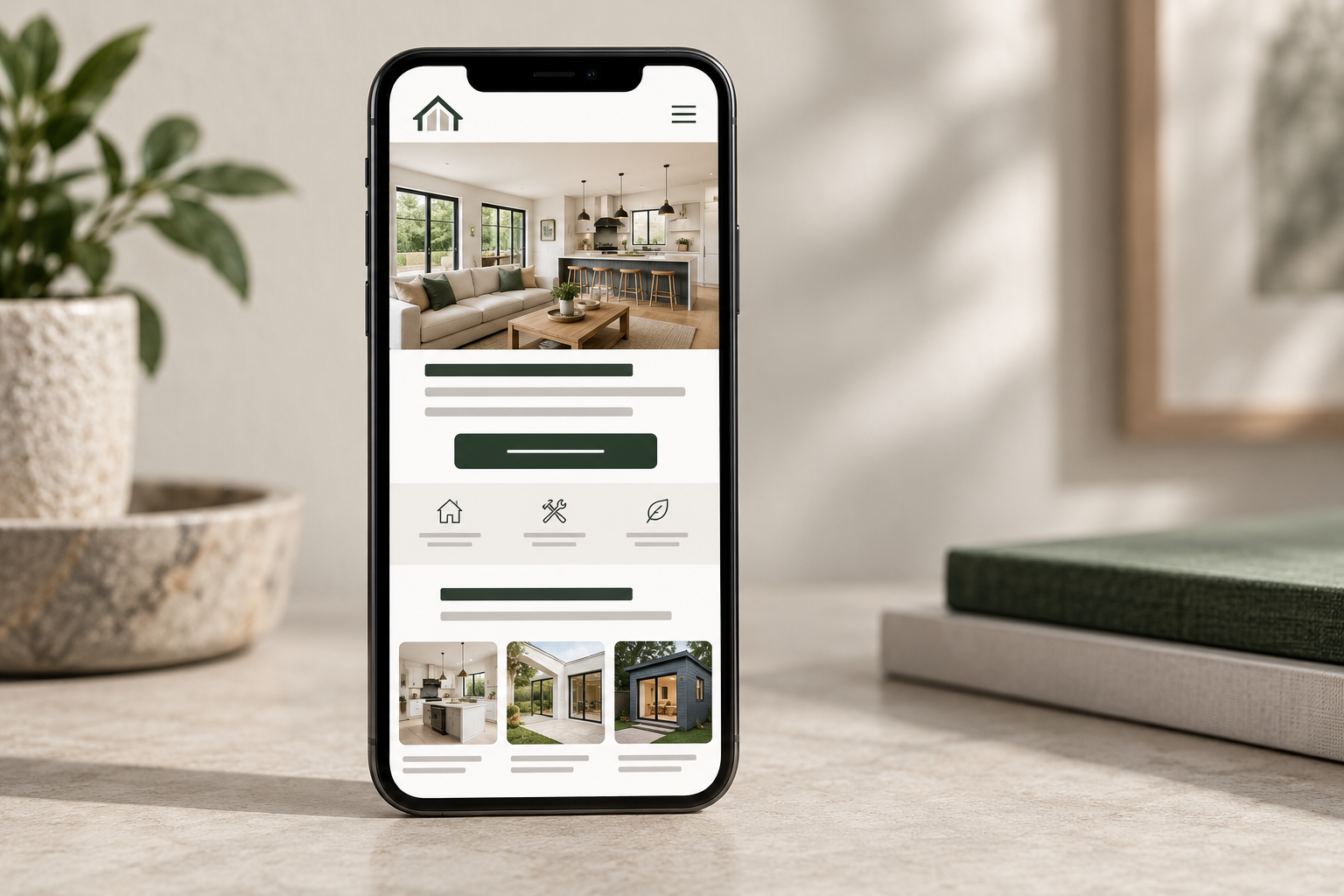
Many homeowners begin researching contractors on a smartphone, compare portfolio examples later on a computer, and return on another device before submitting an inquiry. The experience should remain clear and consistent throughout that process.
A mobile-friendly contractor website should include:
- Readable headings and body copy
- Straightforward navigation
- Appropriately sized project images
- Tap-to-call functionality
- Buttons that are easy to select
- An inquiry experience that is manageable on a phone
- Service and location information that is easy to find
- Consistent spacing and visual hierarchy
- Clear next steps throughout the site
Mobile design should be reviewed independently rather than treated as a smaller copy of the desktop layout. Fast loading pages and restrained media help visitors reach useful information without unnecessary delay.
MOBILE, PERFORMANCE, AND SEO FOUNDATIONS
Create a Stronger SEO Foundation
Website design and search engine optimization are connected, but launching a new construction website does not guarantee search visibility. The initial foundation may include:
- Logical page architecture
- One clear purpose for each page
- Descriptive URLs
- Unique page titles and meta descriptions
- Proper H1 and supporting headings
- Internal links between related pages
- Descriptive image alternative text
- Image compression
- Mobile-friendly layouts
- Appropriate redirects from old URLs
- Google Analytics and Search Console connections
- Local business and service schema when appropriate
- Indexing and crawlability checks
- Consistent company information
Ongoing search work may require additional technical improvements, content development, local optimization, reviews, authority building, performance analysis, and updates based on search data. A useful site also gives a construction company an owned foundation instead of depending entirely on Google Ads, directories, or social platforms for new business.
Protect Existing Performance During a Redesign
When an existing site is replaced, important pages, rankings, backlinks, traffic, inquiries, and conversions should be reviewed before launch. Changing valuable URLs without redirects or removing useful content can disrupt performance.
A redesign should preserve what is already working while improving the parts that limit usability, trust, visibility, or inquiries.
OUR GENERAL CONTRACTOR WEBSITE PROCESS
Plan the Website Around Your Project Priorities
The design process begins with understanding how the company operates, what it builds, where it works, and what customers need to see before starting a conversation.
01. Review the Current Online Presence
We review the existing site, major capabilities, service areas, completed work, project photography, reviews, qualifications, Google Business Profile, search visibility, current inquiries, and long-term goals.
If the contractor does not have a website, we begin by organizing the available business information and identifying the online foundation it needs. This works for established general contractors as well as home builders creating a professional presence for the first time.
02. Plan the Page Structure
We determine which service pages, locations, portfolio features, trust elements, process information, frequently asked questions, and inquiry paths deserve priority.
This step establishes the page structure before individual layouts are designed.
03. Gather Construction Content
We organize the logo, business details, capability information, project photography, reviews, team images, credentials, process details, and other materials needed for the build.
When important content is missing, we identify what should be collected, written, photographed, or confirmed.
04. Write and Design the Website
The copy and page design are developed around the company’s work, construction experience, ideal customers, service area, brand, and goals. Desktop, tablet, and mobile layouts are reviewed throughout the build.
05. Review and Revise
The contractor reviews the site, confirms important information, and requests appropriate revisions. This helps ensure the final presentation accurately represents the company and its work.
06. Launch and Monitor
Before launch, we review links, mobile layouts, metadata, redirects, analytics, and other important elements. After launch, the online presence can be maintained and expanded with new portfolio entries, service pages, locations, reviews, and content.
GENERAL CONTRACTOR WEBSITE FEATURES
What Your Company Website Can Include
The final scope depends on the company, but a professional construction website may include:
- Custom homepage
- Individual construction service pages
- About page
- Construction-process page
- Project portfolio
- Detailed project case studies
- Service-area overview
- Location pages
- Reviews and testimonials
- Frequently asked questions
- Clear inquiry path
- Tap-to-call functionality
- Photo or document upload when supported
- Google Maps integration when appropriate
- Google Business Profile connection
- Social profile links
- Analytics and search tracking
- Basic on-page search optimization
- Mobile and tablet optimization
- Website hosting and ongoing maintenance
- CRM and lead-follow-up integrations
The objective is not to make the company website as large as possible. We recommend the pages and features that support the contractor’s priorities and customer journey. Home builders, residential remodelers, and commercial contractors may need different combinations rather than one universal checklist.
PERSONAL, OWNER-LED SERVICE
A More Personal Approach to Contractor Marketing
With Evergreen Web Solutions, you get a hands-on, personalized approach throughout the planning, design, launch, and ongoing improvement of your online presence. That keeps communication clear and ensures the work stays connected to your actual goals.
Your website, SEO, Google Business Profile, and lead follow-up systems are planned to work together not treated as unrelated services.
01
Direct Communication
Work directly with the person planning, writing, designing, and improving your general contractor website.
02
Built Around Your Construction Company
Shape the website around your project types, service areas, completed work, ideal clients, current capacity, brand, and long-term goals.
03
Able to Grow With Your Business
Add new service pages, locations, project case studies, team information, reviews, and follow-up systems as your company develops.
RELATED GENERAL CONTRACTOR MARKETING SERVICES
A Connected Web Presence for Construction Companies
A professional website provides an important foundation, but it should not operate separately from search visibility, local listings, portfolio proof, reviews, and the customer inquiry process.
SEO for General Contractors
Improve visibility for the construction services and locations that matter to your company through technical SEO, service content, local optimization, internal links, portfolio pages, and ongoing measurement.
Explore SEO for General Contractors →
Digital Marketing for General Contractors
Connect website design, SEO, Google Business Profile support, portfolio presentation, and lead follow-up around the construction work you want more opportunities for.
Explore General Contractor Marketing →
Google Business Profile Optimization
Strengthen the business information, construction services, project photos, reviews, service areas, and connection customers see between the local listing and site in Google Search and Maps. and the appropriate pages on your site.
Lead Capture and Follow-Up
Organize inquiries, customer information, notifications, and follow-up steps using a system connected to your website.
Not sure where to start request a free general contractor website audit
GENERAL CONTRACTOR WEBSITE QUESTIONS
Frequently Asked Questions About General Contractor Web Design
What should a general contractor website include?
A general contractor website should clearly explain the company’s major services, service areas, completed work, process, qualifications, and contact options. It should also provide relevant reviews, useful examples, mobile-friendly layouts, and a straightforward inquiry path.
Why does a contractor need individual service pages?
Major services such as whole-home renovations, additions, ADUs, kitchens, bathrooms, custom homes, garages, decks, and commercial improvements involve different customer questions. Dedicated pages help visitors understand the work and give search engines clearer information about the site.
How should finished projects be displayed?
Strong portfolio features include more than finished photographs. They can explain the type of work, general scope, customer goal, existing conditions, construction considerations, work completed, materials, location when appropriate, and finished result.
Can you redesign my existing contractor website?
Yes. The first step is reviewing the current website to determine what should be kept, improved, reorganized, redirected, rewritten, or replaced. Some websites need targeted improvements, while others benefit from a complete redesign.
Can my website help qualify construction inquiries?
It can improve qualification by clearly explaining the company’s focus, service area, process, and expectations while collecting useful information through a simple inquiry experience. It cannot guarantee that every submission will be a good fit.
Should I display project pricing on my website?
That depends on the contractor’s services and sales process. Construction costs can vary according to scope, property conditions, materials, design, engineering, permitting, labor, access, selections, and other factors. Some companies may benefit from educational cost guidance, while others should begin with a consultation and project review.
How long does it take to build a general contractor website?
The timeline depends on the number of pages, writing requirements, available project photography, requested features, integrations, feedback, and how quickly the necessary business information is provided. A smaller website can usually be completed more quickly than a site with many services, locations, and portfolio case studies.
Can a general contractor website target multiple cities?
Yes. A website can support multiple markets through strong core service pages, useful location content, internal linking, local project evidence, and an accurate Google Business Profile. The contractor should target areas it genuinely serves, and visibility cannot be guaranteed in every city.
Will a new contractor website help my company rank on Google?
A properly planned website can create a stronger foundation through useful service pages, technical structure, mobile usability, metadata, internal links, portfolio proof, and local information. A new website does not guarantee rankings. Competition, authority, reviews, location, content, website history, and ongoing search work can affect visibility for construction companies.
Do you provide hosting and website maintenance?
Yes. Ongoing support can include hosting, security, updates, backups, monitoring, technical assistance, and smaller content changes. The exact scope should be clearly defined in the selected plan or agreement.
Do you provide roofing website hosting and maintenance?
Yes. Ongoing website support can include hosting, security, updates, backups, monitoring, technical assistance, and smaller content changes. The exact services should be clearly defined in your selected plan or agreement.
How much does general contractor website design cost?
The cost depends on the website size, number of service and location pages, copywriting, portfolio requirements, integrations, search setup, custom features, and ongoing support. Evergreen Web Solutions can recommend an appropriate scope after reviewing the company and its current online presence.
READY TO IMPROVE YOUR CONTRACTOR WEBSITE?
Find Out What May Be Limiting Your Best Project Opportunities
Request a free general contractor website audit and tell us about your project types, service areas, current online presence, and the work you want more opportunities for.
We will review the information you provide and identify practical ways to improve how potential clients find, understand, evaluate, and contact your company.
Focused on general contractors and project-based construction companies
Reviews website structure, mobile usability, project presentation, trust, and inquiry paths
Provides clear recommendations without pressure or ranking guarantees
Tell Us About Your Business
Share a few details about your business, current online presence, and what you would like to improve.
Your information will only be used to review your inquiry and follow up about the services you requested.